
Every CNC machine shop faces the same balancing act: run parts faster without letting quality slip. Cycle time targets, tighter tolerances, and shrinking skilled-labor pools all put pressure on the same weak link — workholding. A fixture that takes ten minutes to set up, or that locates a part slightly differently every cycle, quietly erodes both productivity and consistency, no matter how capable the machine tool itself is.
Fixture design directly influences setup time, part positioning, repeatability, cycle efficiency, operator dependency, and overall production consistency. When a locating and clamping system depends on an operator's touch, or forces a manual re-check between parts, the machine spends more time waiting than cutting. This is where turning fixtures, and specifically automated turning fixtures, have become a practical answer for CNC turning operations that need to scale without sacrificing precision.
What Are Automated Turning Fixtures?
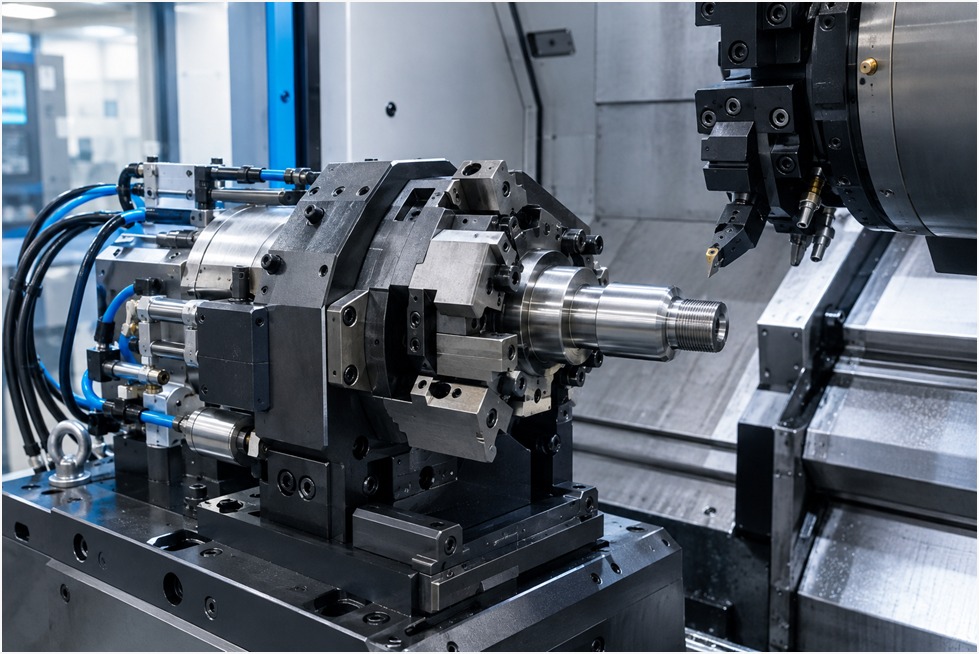
An automated turning fixture is a workholding device built for CNC lathes and turning centers that reduces or eliminates manual clamping steps. Instead of an operator tightening bolts or adjusting jaws by hand, the fixture uses powered actuation — hydraulic or pneumatic — to locate and clamp the workpiece consistently, cycle after cycle.
A typical automated turning fixture combines several elements:
- Locating elements that establish a consistent datum reference for the part
- Clamping mechanisms that apply controlled, repeatable force
- Hydraulic or pneumatic actuation to power the clamping sequence
- Sensors, where required, to confirm clamp state or part presence
- CNC machine controls that sequence the clamping cycle with machining operations
- Automation or robot interfaces for parts loading in unattended or semi-attended cells
A conventional manual fixture relies on operator judgment for clamping force and part seating, which introduces variability from one cycle — or one shift — to the next. An automated fixture standardizes that step, so the locating and clamping sequence behaves the same way regardless of who is running the machine.
How Automated Turning Fixtures Improve CNC Machining Speed
Faster Loading and Unloading
When clamping is powered rather than manual, loading and unloading a part takes a fraction of the time. Combined with robot or automated handling, this removes much of the idle spindle time that occurs while an operator positions and secures a workpiece by hand.
Reduced Setup and Changeover Time
Repeatable locating surfaces mean an operator (or automated system) doesn't need to re-establish reference points for every batch. Quick-change elements and standardized clamping sequences simplify changeovers between similar part families, which matters most in shops running mixed, mid-volume production.
More Consistent Production Cycles
Because the clamping sequence is standardized rather than operator-dependent, cycle-to-cycle variation in loading time and part seating is reduced. This consistency makes cycle time planning and production scheduling more predictable.
Better Machine Utilization
Every minute a spindle isn't cutting is a minute of lost capacity. By reducing manual handling and non-value-add motion, automated CNC workholding increases the proportion of time the machine spends actually machining rather than waiting on the operator.
It's worth noting that automation reduces handling and setup variability — it does not automatically translate into a guaranteed percentage improvement in cycle time, since actual gains depend on part complexity, batch size, and the existing process baseline.
How Automated Turning Fixtures Improve Machining Accuracy
Accuracy in turning depends heavily on how consistently a part is located and held. Automated turning fixtures support this through:
- Repeatable part positioning using fixed locating datums instead of manual alignment
- Stable workpiece support that resists deflection under cutting loads
- Controlled clamping force, avoiding over- or under-clamping that can distort thin-walled or delicate parts
- Reduced workpiece movement during high-speed or interrupted cuts
- Reduced vibration, which helps maintain surface finish and dimensional stability
- Better datum control, keeping the same reference points across an entire production run
- Improved repeatability between shifts, operators, and batches
It's important to be clear: fixture automation alone does not guarantee accuracy. Machine condition, tooling selection and wear, material consistency, locating strategy, and the fundamental fixture design all still matter. An automated fixture built on a poor locating scheme will simply repeat the same error precisely — it won't correct for a flawed design.
Hydraulic vs Pneumatic Automated Turning Fixtures
Both hydraulic and pneumatic actuation are used in automated CNC workholding, and the right choice depends on the application rather than one technology being universally superior
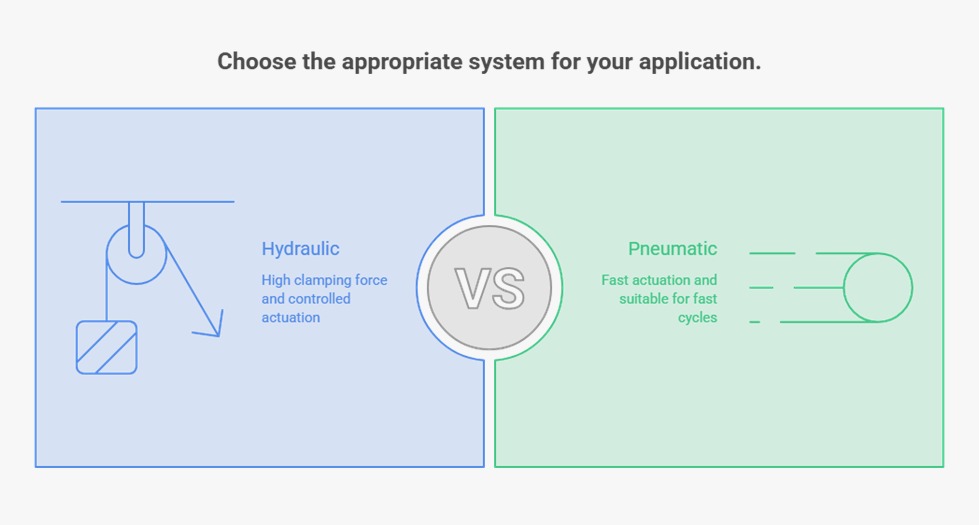
| Factor | Hydraulic | Pneumatic |
|---|---|---|
| Clamping force | High | Moderate |
| Actuation | Controlled | Fast |
| Typical application | Heavy/high-load machining | Fast-cycle applications |
| Automation | Suitable | Suitable |
| Maintenance | Requires hydraulic system care | Requires clean compressed air |
Hydraulic turning fixtures are generally favored where high clamping force and controlled actuation are needed, such as heavier components or interrupted cuts. Pneumatic fixtures are often chosen where cycle speed matters more than raw clamping force, provided the application can tolerate moderate clamping loads and a clean, reliable compressed-air supply.
Key Features to Look for in an Automated Turning Fixture
A well-engineered turning fixture should offer:
- A rigid locating system that resists deflection
- Consistent, repeatable clamping
- Proper tool and turret clearance
- Effective chip evacuation to prevent interference with locating surfaces
- Sensor or confirmation systems for clamp/part-present verification
- CNC/PLC integration for synchronized cycles
- Robot compatibility for automated cells
- Ease of maintenance and serviceability
- Repeatable positioning across tool and fixture changes
- Part protection against marking or distortion
- Quick changeover capability for mixed production
Fixture selection should always be based on part geometry, the specific machining operation, production volume, the machine's interface and envelope, expected cutting forces, and the level of automation required — not a one-size-fits-all template.
Automated Turning Fixtures and Industry 4.0 Manufacturing
Smart manufacturing trends are gradually extending into workholding. Practical, currently deployable features include sensors for clamp confirmation, part-presence detection, and basic cycle data logging that feeds into a CNC or PLC network. This kind of connectivity supports predictive maintenance planning and gives production teams better visibility into fixture performance over time.
More advanced concepts — such as fully autonomous "lights-out" machining cells, digital twins of the fixture-machine system, and AI-driven adaptive clamping — are areas of active research and development rather than universally deployed shop-floor technology. Manufacturing researchers continue to study the role of sensors, actuators, connectivity, and cyber-physical systems in intelligent workholding, but shops evaluating automated fixtures today should distinguish between what is practical now and what remains emerging.
Applications of Automated Turning Fixtures
Automated turning fixtures are used across a range of industries, including automotive components, pumps and valves, general engineering, agricultural equipment, heavy machinery, aerospace components, power and energy equipment, and construction machinery. Requirements vary significantly by component geometry, tolerance requirements, production volume, and the specific turning operations involved — a high-volume automotive shaft and a low-volume valve body call for very different fixture strategies.
How to Choose the Right Automated Turning Fixture
Before specifying a fixture, evaluate:
- Component drawing and geometry
- Material and its machinability
- CNC machine type and available interfaces
- Machining operations to be performed
- Expected cutting forces
- Required tolerances
- Production volume
- Loading and unloading method
- Hydraulic or pneumatic supply availability
- Automation and robot-integration requirements
- Inspection and verification requirements
- Ongoing maintenance requirements
Working through this list with a fixture design partner early — ideally alongside the part drawing helps avoid costly rework after a fixture is built.
Why Custom Turning Fixtures Can Be Better for Production
Standard or catalog workholding works well for simple, low-volume jobs. But custom turning fixtures often make more sense for complex components, high-volume production, parts requiring multiple machining operations in one setup, tight tolerances, automated loading systems, or special locating requirements that a generic fixture can't accommodate. A process-specific design can also reduce setup time by building the exact clamping and locating sequence around how the part is actually produced, rather than adapting the part to a general-purpose fixture.
Working With an Experienced Fixture Manufacturer
CMD Engineering Solutions, based in Coimbatore, Tamil Nadu, designs and manufactures hydraulic, pneumatic, and mechanical fixtures along with special purpose machines and automation integration for CNC, VMC, and HMC applications. The company's work spans sectors including automotive, pumps and valves, general engineering, agriculture, heavy vehicles, power and energy, and marine and aerospace components — industries where workholding requirements differ significantly by part geometry and production volume.
Reviewed by: This article reflects general CNC workholding engineering principles and has been reviewed for technical accuracy by CMD Engineering Solutions' fixture design team.
Frequently Asked Questions
1. What are turning fixtures used for in CNC machining?
Turning fixtures hold and locate a workpiece on a CNC lathe or turning center so it can be machined accurately and repeatedly. They establish a stable reference position, resist cutting forces during the operation, and ensure that every part in a production run is held in the same orientation for consistent results.
2. How do automated turning fixtures improve CNC machining accuracy?
Automated turning fixtures use repeatable locating elements and controlled clamping force to reduce the variation that comes from manual setup. This supports better datum control, less workpiece movement during cutting, and more consistent repeatability across shifts, operators, and production batches.
3. Are automated turning fixtures suitable for high-volume production in India?
Yes, automated turning fixtures are well suited to high-volume CNC production, including in India's growing automotive, pump and valve, and general engineering sectors. They reduce manual handling time and setup variation, which becomes increasingly valuable as batch sizes and shift counts grow.
4. How do I choose a turning fixture manufacturer in Coimbatore?
Look for a manufacturer with demonstrated experience in hydraulic, pneumatic, or mechanical fixture design, a clear engineering and design process, and the ability to review your part drawings, tolerances, and production volumes before proposing a fixture concept. Ask about their design, manufacturing, and validation capabilities directly.
5. What is the difference between hydraulic and pneumatic turning fixtures?
Hydraulic turning fixtures typically provide higher, more controlled clamping force and suit heavier or high-load machining. Pneumatic fixtures actuate faster and suit fast-cycle applications with moderate clamping force needs. The right choice depends on part weight, cutting forces, and required cycle speed.
6. Can automated turning fixtures be integrated with CNC machines and robots?
Yes. Automated turning fixtures are commonly integrated with CNC and PLC controls to synchronize clamping with the machining cycle, and with robotic loading/unloading systems for semi-automated or fully automated production cells, depending on volume and part handling requirements.
Ready to Discuss Your Turning Fixture Requirements?
If you're evaluating automated workholding for a new or existing CNC turning operation, the next step is a technical conversation grounded in your actual part drawings and process. Share your component drawings, target machine details, production volumes, and any automation requirements, and a fixture design team can advise on whether a standard or custom turning fixture hydraulic or pneumatic fits your process best.
Contact our engineering team