
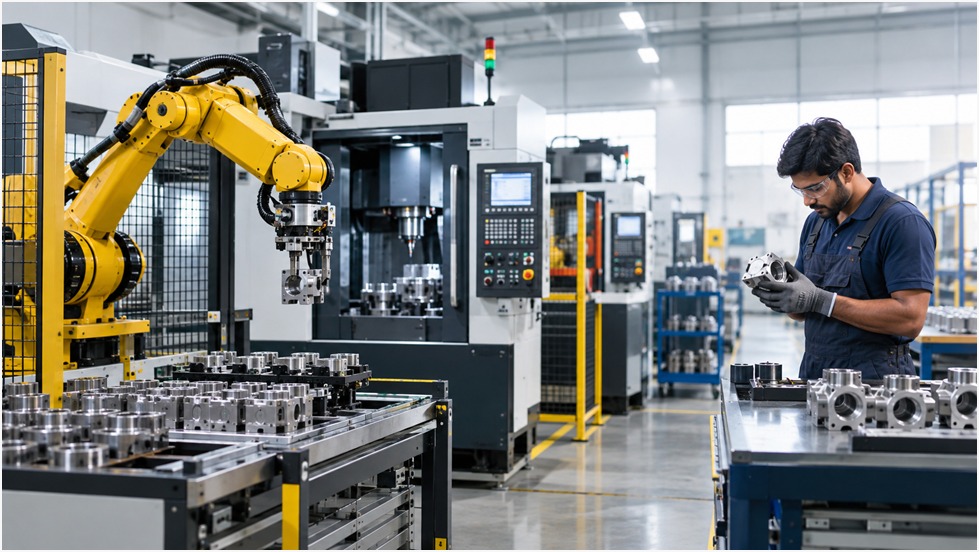
Manufacturers often face a practical question when production demand increases: should the process continue with manual operations, or is it time to introduce automation?
There is no single answer. Manual manufacturing can provide flexibility and lower initial investment, while automation can improve repeatability, production consistency and process control. The right approach depends on production volume, component design, cycle time, labour requirements, quality expectations and the type of operation being performed.
For many manufacturers, the most practical solution is not complete automation. Semi-automation can automate repetitive or demanding operations while allowing operators to remain involved where human judgment is still valuable.
What Is Manual Manufacturing?
Manual manufacturing relies primarily on operators to perform production activities. Depending on the process, workers may handle component loading, unloading, inspection, assembly, positioning, material movement or machine operation.
Manual production can be useful when:
- Production volumes are relatively low
- Products change frequently
- Components require frequent adjustments
- The process is still being developed
- Operator judgment is important
- Automation investment cannot yet be justified
However, manual processes can also introduce variation. Fatigue, inconsistent handling, positioning errors and differences between operators may affect cycle time and process consistency.
This does not mean manual manufacturing is unsuitable. In many factories, skilled operators remain essential, particularly for setup, inspection, troubleshooting and processes requiring adaptability.
What Is Industrial Automation?
Industrial automation uses machines, control systems, sensors, robotics, fixtures and other technologies to perform specific manufacturing activities with reduced manual intervention.
Automation can range from a simple automated loading mechanism to a complete robotic production cell.
Common examples include:
- Automated machine loading and unloading
- Part transfer systems
- Robotic material handling
- Automated assembly
- Machine tending
- Automated inspection
- Pneumatic or hydraulic clamping
- Conveyor-based movement
- Process monitoring and control
- Robotic process integration
Modern manufacturing automation does not necessarily mean removing operators from the process. In many applications, technology takes over repetitive or physically demanding work while employees supervise, adjust and manage the production system.
NIST identifies machine tending, material handling, automated visual inspection and robotic applications among common manufacturing automation uses.
Manual Manufacturing vs Automation: Key Differences
| Factor | Manual Manufacturing | Automated Manufacturing |
|---|---|---|
| Human involvement | High | Reduced for automated operations |
| Initial investment | Usually lower | Usually higher |
| Production consistency | Depends strongly on operator | More repeatable when properly designed |
| Flexibility | High for changing tasks | Depends on system design |
| Cycle time | Can vary | Can be more consistent |
| Repetitive work | Operator-dependent | Suitable for automation |
| Data collection | Often limited | Can be integrated into controls and monitoring |
| Maintenance | Mainly conventional equipment | Requires automation and control expertise |
| Scalability | Often requires additional labour | Can support higher production volumes |
The table highlights an important point: automation is not automatically better for every manufacturing process. The system needs to solve a real production problem.
Benefits of Industrial Automation
1. Better Process Consistency
Machines can repeat a programmed movement or sequence with controlled parameters. When fixtures, tooling and process controls are properly designed, this can reduce variation between production cycles.
2. Reduced Repetitive Manual Work
Automation is particularly useful for repetitive operations such as loading, unloading, transferring or positioning components. This allows operators to spend more time on activities requiring supervision, problem-solving and process decisions.
3. More Predictable Cycle Time
Manual handling can introduce differences in cycle time. Automation can make specific stages of a production process more consistent, helping manufacturers understand capacity and production requirements more accurately.
4. Improved Material Handling
Robotic systems and automated handling equipment can move components between defined process points. This can be valuable where components are heavy, repetitive to handle or difficult to position manually.
5. Better Process Monitoring
Modern automation systems can incorporate sensors, controls and data collection. This can provide manufacturers with better visibility into machine conditions and production performance. NIST notes that advanced manufacturing technologies can support process optimization, shorter cycle times, quality improvement and reduced downtime.
Limitations and Challenges of Automation
Automation also has limitations that should be considered before implementation.
Higher Initial Investment
Automation requires investment in equipment, controls, integration, fixtures, safety systems and commissioning. The business case should therefore consider expected production volume, labour requirements, cycle-time improvements and long-term operating costs rather than only the equipment price.
Process Changes May Be Required
A process designed for manual production may not immediately be suitable for automation. Component orientation, access, clamping, loading points and inspection methods may need modification.
Maintenance and Technical Support
Automated systems contain mechanical, electrical and control components. Proper preventive maintenance and trained personnel are important for reliable operation.
Safety Must Be Designed In
Robotic and automated equipment requires appropriate risk assessment and safeguarding. ISO 12100 provides principles and methodology for machinery risk assessment and risk reduction, while ISO 10218-1:2025 addresses safety requirements for industrial robots.
When Does Semi-Automation Make Sense?
Semi-automation is often useful when a manufacturer wants to improve a specific part of a process without automating the entire production line.
For example, an operator may manually load a component into a fixture while an automated mechanism performs clamping, machining transfer or another repetitive operation. The operator can then unload the finished component and perform the next required task.
This approach can be practical when production volumes are moderate, product variations are common or complete automation would involve unnecessary complexity.
CMD Engineering specifically provides process solutions with semi-automation and develops automation around the component, production process and manufacturing requirements.
Applications of Manufacturing Automation
Manufacturing automation can be applied across several industries and processes, including automotive components, agriculture equipment, machine tools, pumps and valves, power and energy equipment, aerospace, marine applications and general engineering.
Typical applications include:
- CNC machine tending
- Component loading and unloading
- Automated assembly
- Robotic handling
- Inspection processes
- Material transfer
- Special purpose machines
- Automated work-holding
- Process integration
CMD Engineering also combines automation with fixtures, tooling, machining technologies and robotic integration for application-specific manufacturing requirements.
How to Decide Between Manual and Automated Manufacturing
Before investing in automation, evaluate the complete process rather than one operation.
Ask:
- How many components are produced per shift or month?
- Which tasks are repetitive?
- What is the current cycle time?
- Where does process variation occur?
- Are operators spending significant time on material handling?
- Does the component require consistent positioning?
- How frequently does the product change?
- What level of automation can the existing machine support?
- What safety measures will be required?
- Can the expected improvement justify the investment?
A process study should ideally identify the current cycle time, operator movements, machine utilization, quality issues and bottlenecks before selecting an automation concept.
Final Takeaway
Manual manufacturing and industrial automation are not opposing solutions in every situation. Manual operations provide flexibility and human judgment, while automation can provide repeatability, controlled cycle times and reduced repetitive work.
For manufacturers evaluating Industrial Automation coimbatore, the important step is to identify where automation can solve a measurable production problem rather than automating simply because the technology is available.
In many cases, a carefully designed semi-automated process can provide a practical middle ground. The best solution is the one that fits the component, production volume, process requirements, workforce, safety needs and long-term manufacturing goals.
Frequently Asked Questions
1. How do I know if my process is suitable for automation?
Check production volume, cycle time, repetitive tasks, process variation and quality requirements.
2. Does production volume affect automation decisions?
Yes. Higher production volumes generally provide more opportunity to justify automation investment.
3. Which manufacturing tasks are suitable for automation?
Machine loading, unloading, material handling, assembly, inspection, positioning and repetitive operations are common examples.
4. What should I check before automating an existing machine?
Check machine compatibility, available space, controls, cycle time, workholding, component handling and safety requirements.
5. How do I determine whether automation is worth the investment?
Compare the automation cost with expected improvements in productivity, cycle time, labour utilization, quality and production capacity.