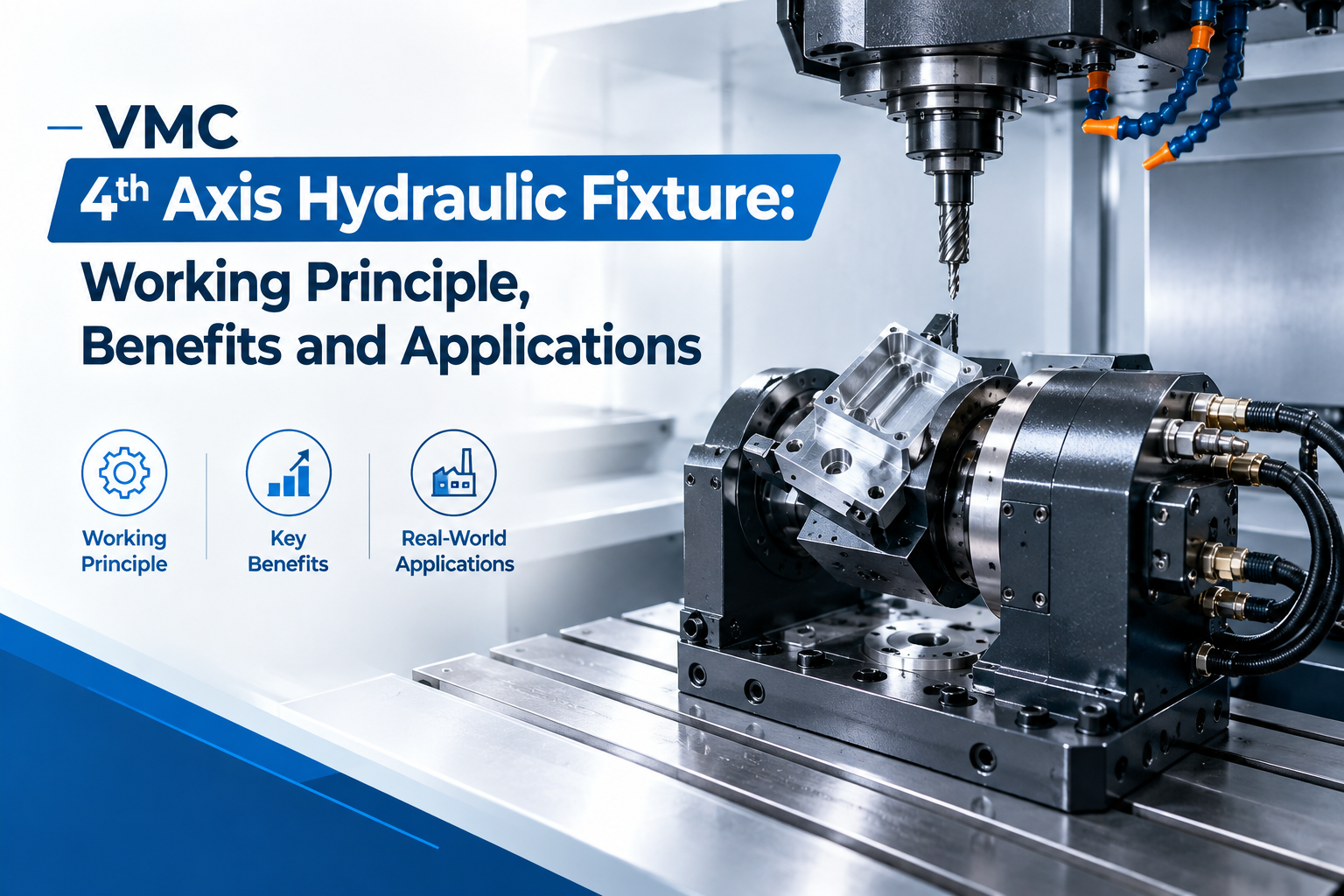
Machining a part on several faces often means stopping the machine, unclamping the part and setting it up again. Every repositioning increases setup time and the possibility of misalignment. A VMC 4th Axis Hydraulic Fixture tackles both problems by pairing hydraulic clamping with rotary positioning on a Vertical Machining Centre.
The fixture securely holds the component while the fourth axis rotates it to the subsequent machining angle. Understanding how it works and what to check before buying helps manufacturers pick a setup that fits their parts and production goals.
What Is a VMC 4th Axis Hydraulic Fixture?
It is a workholding device made for VMCs fitted with a rotary fourth axis. Hydraulic pressure drives the clamps that hold the workpiece in place.
X, Y, and Z are the three linear axes along which a typical VMC travels. The fourth axis adds rotation, so the cutting tool can reach other sides of the part without taking it off the fixture. A typical 4th axis VMC fixture includes a base or body, locating pins or pads, hydraulic clamps, support elements and a connection to a hydraulic power unit.
Compared with hand-tightened clamps, hydraulic clamping applies force through a designed circuit, so the grip is more uniform from one cycle to the next. The rotary table's capacity, machine compatibility, tool clearance, and part size all affect what the fixture can actually handle.
How the Fixture Works
A typical cycle runs like this:
- Loading: The operator seats the part against the locating surfaces or pins.
- Clamping: The hydraulic unit pressurises the circuit and the clamps close on the part.
- Indexing: The part is turned to the predetermined angle using the rotary axis.
- Machining: The VMC performs milling, drilling, boring or other operations.
- Release: After machining and with the system in a safe state, the clamps open and the part is removed.
Pressure setting matters. Too little force lets the part shift under cutting loads, while too much can distort thin or delicate sections. Safe operator access, chip flow, cutting forces, and part rigidity are all taken into consideration in good design. Operators should always follow the machine's safety procedures before reaching into the clamping area.
Key Benefits
When designed and maintained properly, a hydraulic clamping fixture can offer:
- Steady clamping force: Each cycle uses the same hydraulic setting, reducing the variation of hand tightening.
- Repeatable positioning: Fixed locating features place similar parts in the same spot every time.
- Less operator effort: One hydraulic action can replace tightening several clamps manually.
- Shorter handling time: Fewer reclamping steps can cut non-cutting time.
- Multi-face access: Rotation exposes more surfaces in a single setup.
- Consistent output: A controlled loading and clamping routine reduces setup-related variation.
These gains are not automatic. Results depend on fixture design, machine condition, tooling and operator practice, so trial runs are a better guide than assumed percentages.
Where These Fixtures Are Used
A 4 axis machining fixture suits parts that need controlled positioning and work on more than one face. Common uses include:
- Automotive: Housings, brackets and mounting components.
- Precision metal parts: Components needing accurate alignment during milling and drilling.
- Industrial machinery: Machine elements, structural parts and equipment housings.
- General engineering: Custom parts in small batches or repeat orders.
- Production lines: Recurring jobs on compatible VMCs with rotary axes.
Not every part benefits from a fourth axis. Review the geometry, material, machining sequence and volume first.
How to Choose the Right Fixture
Start with the part, then the process. Key points to review:
- Size and weight: The part and fixture must fit the work envelope and stay within the rotary table's load limit.
- Clamping force: It should resist cutting loads without deforming the part.
- Faces and angles: List the surfaces to machine and the index positions needed to reach them.
- Machine compatibility: Check mounting pattern, hydraulic connections and control requirements.
- Tool clearance and chips: Clamps must stay out of the tool path, and chips and coolant should clear locating surfaces.
- Volume and repeatability: High-volume work favours quick loading and minimal operator variation.
Planning hose routing, leak inspections, serviceable access, and appropriate guarding are all important aspects of safety and maintenance.
Why a Custom Design Often Makes Sense
Parts differ in datum surfaces, wall thickness and machining challenges, so a generic fixture rarely gives the best support. A custom VMC fixture lets engineers design around the actual component, which is where application engineering comes in.
CMD Engineering lists VMC fourth-axis hydraulic fixtures among its workholding solutions, alongside mechanical, pneumatic and other specialised fixtures, and its engineering services cover fixture design, tooling, prove-out and process optimisation. To get a useful proposal from any fixture maker, share component drawings, material details, machine specifications, planned operations and production targets, along with any known clamping difficulties.
Conclusion
A well-planned VMC 4th Axis Hydraulic Fixture can hold parts securely, open up multiple faces in one setup and reduce repeated manual handling. Its value rests on correct clamping, reliable locating, machine compatibility and safe design.
Frequently Asked Questions
1. What is a VMC 4th axis hydraulic fixture?
A workholding system that clamps a part hydraulically on a VMC with a rotary axis, allowing machining at several indexed angles.
2. How does it improve machining?
It can cut repeated repositioning and expose more faces in one setup, depending on the part and machine configuration.
3. What are the main benefits of hydraulic clamping?
Consistent clamping, less manual effort, repeatable positioning and possible setup-time savings.
4. Which industries use these fixtures?
Automotive, general engineering, industrial machinery and precision component manufacturing.
5. How do I choose a fixture manufacturer?
Pick one that understands your part geometry, clamping needs and machine compatibility, and share drawings and production details before the design is finalised.
Need a Fixture Built Around Your Component?
Before choosing, review your part geometry, machining sequence, clamping needs and volume. If you want a fixture built around your component and machine, contact CMD Engineering to discuss your requirements.
Contact CMD Engineering